Blender Not Blending? 10 Reasons Why (and How to Fix Each One)
From air pockets and stuck ingredients to a blender that won't turn on at all
As an Amazon Associate I earn from qualifying purchases. If you buy through links on this page, we may earn a small commission at no extra cost to you. Details.
You press the button, the motor roars, and… nothing happens. The blades spin, but the frozen fruit sits there untouched. Or maybe the blender won’t even turn on.
A blender that won’t blend is one of the most frustrating kitchen problems, but it’s also one of the easiest to fix. In most cases, nothing is broken. The ingredients just need a little help, or a safety feature is doing its job.
This guide covers the 10 most common reasons a blender won’t blend, split into two groups: the blender runs but doesn’t blend, and the blender won’t turn on or stops. Start with whichever matches your problem.

Safety first: Always unplug the blender before reaching into the jar, removing the blade assembly or inspecting the base. Never use a spoon, spatula or your hand inside the jar while it’s plugged in.
Part 1: The blender runs, but doesn’t blend
1. An air pocket has formed (cavitation)
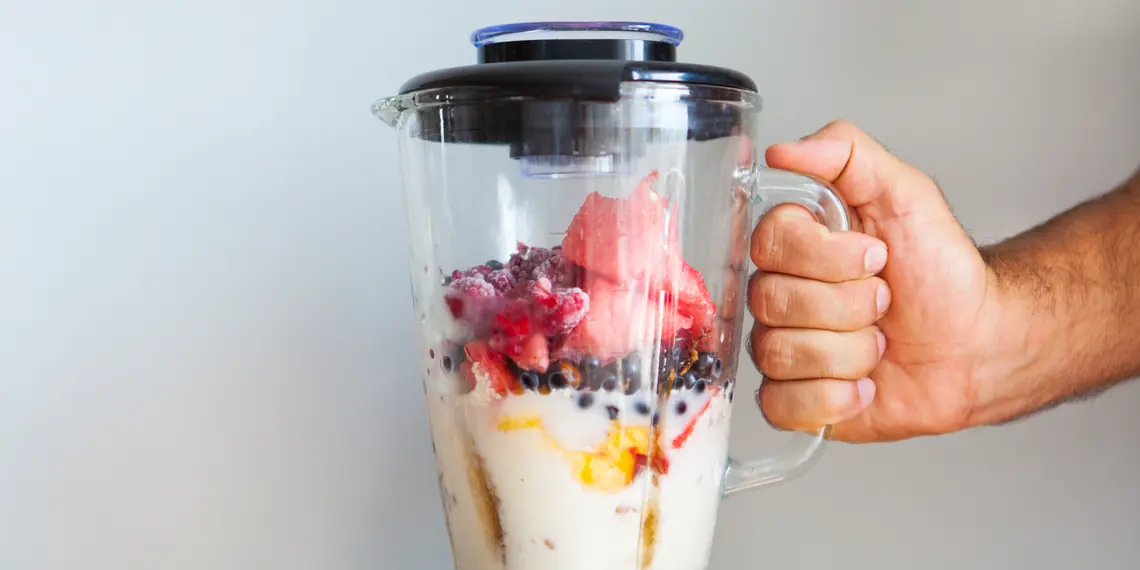
This is by far the most common problem. The blades carve out a hollow space around themselves and spin freely in the air, while the ingredients above sit in a solid dome and never reach the blades.
It happens most with thick, frozen mixtures like smoothie bowls, frozen fruit and nice cream.
How to fix it:
- Stop, unplug and stir the ingredients down with a spatula, then try again.
- Add a splash of liquid, a tablespoon or two at a time.
- Use the tamper if your blender has one. It’s designed to push ingredients into the blades while the blender runs.
- Pulse a few times to shake things loose, then blend.
2. Not enough liquid
Blenders need liquid to create a vortex, the whirlpool that pulls ingredients down into the blades. Without enough, even a powerful blender will struggle, and a conventional one may barely move anything.
How to fix it:
- Add liquid gradually until the mixture starts circulating.
- For thick smoothies, start with more liquid than you think and add frozen ingredients slowly.
- If you want a thick result, use frozen banana or yogurt rather than cutting liquid too far.
3. Ingredients loaded in the wrong order
If ice or frozen fruit goes in first, it sits right on the blades and jams them, with the liquid trapped above.
How to fix it: Load in this order: liquids first, then powders and greens, soft fruit, and frozen ingredients or ice last. The weight of the frozen items on top pushes everything down into the blades.
Our full guide to the right order to add smoothie ingredients explains why this works, and the exception for personal blenders.
4. The jar is overfilled
A packed jar leaves no room for ingredients to move. The mixture can’t circulate, so only the bottom layer gets blended.
How to fix it:
- Stay below the max fill line, and lower for thick mixtures.
- Blend in two smaller batches.
- Personal blenders are especially sensitive to overfilling, because they’re designed for single servings.
5. Ingredients are too big or too frozen
Whole frozen strawberries straight from a very cold freezer, big chunks of ice or large pieces of hard vegetables can be too much for many blenders, especially conventional and personal ones.
How to fix it:
- Cut ingredients into smaller pieces before freezing or blending.
- Let frozen fruit sit for 5 minutes to soften slightly.
- Use smaller ice cubes. See our guide on crushing ice in a blender for the right technique.
6. Starting on high speed
Jumping straight to high speed with thick ingredients can create an air pocket instantly, before anything has a chance to settle into the blades.
How to fix it: Start on low for a few seconds to let the ingredients settle and start moving, then increase gradually. Many blenders’ preset programs do this automatically.
7. The drive coupling is worn (blades spin slowly or not at all)
If the motor sounds like it’s running normally but the blades barely turn, or they spin without much power, the drive coupling may be worn. This is the part that connects the motor to the blade assembly. When its teeth are rounded off, the motor spins but can’t turn the blades properly.
You might also hear grinding or rattling, or smell burning rubber.
How to fix it:
- Unplug the blender and remove the jar.
- Look at the drive socket on the base and the matching part underneath the jar or blade assembly.
- Look for rounded, chipped or melted teeth.
- Replace the worn part. Many brands sell replacement drive sockets or couplings for specific models.
For more on this, see why a blender smells like burning, which covers worn couplings in detail.
8. The blades are damaged or the blade assembly is worn
Blender blades aren’t meant to be razor sharp. Many work by smashing food at high speed. But blades can bend or chip if they hit something hard (like a spoon or a fruit pit), and the bearing they spin on can wear out.
How to tell: Unplug the blender and carefully inspect the blades. Look for bent or chipped edges. If you can, turn the blade by hand (from underneath, carefully). It should turn smoothly, without grinding or wobbling.
How to fix it: Replace the blade assembly if your model allows it, or replace the jar if the blades are built in.
Part 2: The blender won’t turn on or keeps stopping
9. The jar or lid isn’t locked in place (safety interlock)
Many modern blenders, especially many Ninja models and most personal blenders, have safety interlocks. The motor won’t run unless the jar is seated correctly, and on some models, the lid must also be locked or the handle aligned.
This is one of the most common “my blender is broken” calls, and there’s nothing wrong at all.
How to fix it:
- Reseat the jar firmly on the base, turning or pressing it until it clicks into place (depending on the model).
- Lock the lid fully. On pitchers with a locking lid, the handle and lid tab often need to line up.
- Check the arrows or markings on the jar and base, which show how they should align.
- For personal blenders, make sure the cup is screwed tightly onto the blade base and pressed or turned down firmly onto the motor.
- Check that nothing, like dried smoothie or a stray gasket, is stopping the jar from sitting flat.
10. Power, overheating or an electrical problem
If the blender is completely dead, or it keeps stopping mid-blend, work through these checks:
Power basics:
- Is it plugged in firmly? Try a different outlet you know works.
- Kitchen outlets are often GFCI (ground-fault) outlets. Check whether it has tripped and press the reset button.
- Check your circuit breaker.
- Some blenders need a power switch turned on at the back or bottom of the base before the controls work.
Overheating (thermal protection): If the blender stopped mid-blend and won’t restart, its thermal overload protection may have switched it off to protect the motor. This usually happens after long, heavy blends.
- Unplug it and let it cool completely. Manuals often recommend waiting 30–45 minutes or more.
- When you restart, use more liquid and shorter bursts.
Electrical fault: If there’s a burning smell, smoke or sparks, or the blender still won’t work after all these checks, stop using it and contact the manufacturer, especially if it’s under warranty. It’s also worth checking the Consumer Product Safety Commission recalls database (US) for your model.
Tip: Many manufacturers publish troubleshooting guides and manuals online, for example Ninja, Vitamix and NutriBullet. The manual often has a section on exactly why that model won’t start.
Quick troubleshooting checklist
| Symptom | Try this first |
|---|---|
| Blades spin in a hollow, nothing moves | Stop, stir, add liquid, use the tamper |
| Only the bottom layer blends | Don’t overfill; load liquids first, frozen last |
| Frozen fruit won’t break down | Smaller pieces, let it soften, start on low |
| Motor runs, blades barely turn | Check the drive coupling for worn teeth |
| Grinding noise, blade wobbles | Inspect the blades and bearing; replace the blade assembly |
| Won’t turn on at all | Reseat the jar, lock the lid, check the outlet and GFCI |
| Stopped mid-blend, won’t restart | Thermal protection: unplug and let it cool |
| Smoke, sparks or burning smell | Unplug and stop using it; contact the manufacturer |
Most blenders that “won’t blend” aren’t broken. They’re missing liquid, overfilled, or waiting for the jar to click into place.
How to keep your blender blending well
- Always load liquids first and frozen ingredients last.
- Use enough liquid, then adjust thickness at the end.
- Start low, go high.
- Don’t overfill. Blend in batches.
- Keep the drive socket clean and dry, so dried residue doesn’t stop the jar seating properly.
- Clean right after use with the quick self-clean method in our 60-second cleaning guide.
- Watch for leaks around the blade base. A worn gasket can let liquid into the motor. See how to fix a blender leaking from the bottom.
Is it time for a new blender?
If you regularly make thick smoothie bowls, frozen desserts or nut butters and your blender always struggles, even with good technique, you may simply need a more capable machine. Consider:
- A blender that comes with a tamper, which makes thick blends much easier
- Variable speed control, so you can start slow
- A long warranty, which says a lot about how long the motor is expected to last
Our guide to personal, full-size and high-performance blenders explains which type suits which jobs.
Frequently asked questions
Why is my blender spinning but not blending?
Usually because an air pocket has formed around the blades, so they spin freely while the ingredients above don’t move. Stop, stir, add a little liquid and use the tamper if you have one. If the motor runs but the blades barely turn, check the drive coupling for worn teeth.
Why won’t my blender turn on?
The most common reason is a safety interlock: the jar or lid isn’t locked in place. Reseat the jar until it clicks and lock the lid. Then check the outlet, any GFCI reset button, your breaker and any power switch on the base.
Why does my blender stop in the middle of blending?
Many blenders have thermal overload protection that shuts the motor off when it gets too hot, usually after long or heavy blends. Unplug it, let it cool completely, then continue with more liquid and shorter bursts.
How do I blend frozen fruit without adding a lot of liquid?
Load a small amount of liquid first, add frozen fruit last, start on low speed and use a tamper to push the fruit into the blades. Letting the fruit soften for a few minutes also helps.
Can blender blades get dull?
Blender blades can wear, bend or chip over time, but many are designed to be fairly blunt and work by speed. Poor blending is more often caused by technique, air pockets or a worn drive coupling than by dull blades.
The bottom line
When a blender won’t blend, start with the simple fixes: stir out the air pocket, add liquid, load ingredients in the right order, and don’t overfill. If it won’t turn on, make sure the jar and lid are locked in place before worrying about the motor. Only when those don’t work is it time to look at worn couplings, blades or electrical problems.
Next, learn how to crush ice without damaging your blender, or how to blend hot soup safely.

We research blenders so you don't have to: we compare specs, warranties and thousands of owner reviews, and write practical guides for getting more out of the blender you already have.