How Long Do Blenders Last? Signs It's Time to Repair or Replace Yours
Typical lifespans by blender type, 8 warning signs, and how to decide between fixing and buying new
As an Amazon Associate I earn from qualifying purchases. If you buy through links on this page, we may earn a small commission at no extra cost to you. Details.
A blender isn’t a lifetime purchase, but a good one, looked after well, can last many years. The question is: when is your blender simply due a new part, and when is it time to replace the whole thing?
This guide covers typical lifespans by blender type, what shortens a blender’s life, eight warning signs to watch for, which parts you can replace, and a simple way to decide between repairing and buying new.
How we researched this: Lifespans vary widely by model, use and care. The ranges below are general estimates based on how different blender types are built, typical warranty lengths and long-term owner feedback, not guarantees. Your manual and warranty terms are the best guide for your model.
How long do blenders last?
| Blender type | Typical lifespan (general estimate) | Notes |
|---|---|---|
| Personal / bullet | A few years with regular use | Small motors work hard; cups and blade bases often wear first |
| Full-size conventional | Several years | Varies a lot by price and build quality |
| High-performance | Often many years | Built for daily heavy use; long warranties are common |
| Immersion (stick) | Several years | Light-duty use extends lifespan |
Warranty length is one of the best clues. Manufacturers back their motors for as long as they’re confident they’ll last. A blender with a long warranty is usually built to go the distance.
What shortens a blender’s life?
- Overloading. Thick mixtures, too little liquid and overfilled jars strain the motor.
- Long, continuous runs. Motors overheat. Thermal protection helps, but repeated overheating wears components.
- Hard objects. Pits, bones, utensils and very large ice cubes can bend blades and damage couplings.
- Liquid in the motor base from leaks or careless cleaning.
- Soaking or dishwashing parts that aren’t designed for it, which can wash lubricant out of blade bearings.
- Poor cleaning. Dried residue around the drive socket and gasket causes wear and leaks.
8 signs your blender is wearing out
1. A burning smell during normal use
Occasional smells when overloaded can be fixed with better technique. A smell during light, liquid-rich blends suggests a failing motor or worn parts. See why a blender smells like burning.
2. The motor runs but the blades barely turn
Usually a worn drive coupling, which is often a cheap part to replace.
3. Grinding, squealing or rattling
Often a worn blade bearing (replace the blade assembly) or a worn coupling. New noises are worth investigating. See how to make a blender quieter for the difference between normal and warning noises.
4. Leaking from the bottom
A worn gasket or blade seal, or a cracked jar. Usually fixable. See blender leaking from the bottom and our gasket guide.
5. It struggles with jobs it used to handle
If technique hasn’t changed, the motor may be weakening, or the blade assembly may be worn. Check the blades first. See can you sharpen blender blades?.
6. It shuts off often
Frequent thermal shutdowns during ordinary blends suggest the motor is struggling or cooling is impaired.
7. Cracked or badly damaged jar
Cracks, deep scratches and chips (especially on glass) mean it’s time for a new jar. Cloudiness alone is usually cosmetic. See how to clean a cloudy blender jar.
8. Electrical problems
Flickering controls, sparks, smoke, a hot or damaged cord, or tripping breakers. Stop using it immediately and contact the manufacturer. Check whether your model has been recalled on the Consumer Product Safety Commission recalls database (US).
Which parts can you replace?
| Part | Common problem | Usually replaceable? |
|---|---|---|
| Gasket / sealing ring | Leaks, mold, smells | Yes, and cheap |
| Blade assembly | Bent blades, worn bearing, leaks from center | Often (unless built into the jar) |
| Drive coupling / socket | Blades slip, burning rubber smell | Often |
| Jar / container | Cracks, deep scratches | Usually |
| Lid and lid plug | Cracks, lost parts | Usually |
| Tamper | Lost or damaged | Usually |
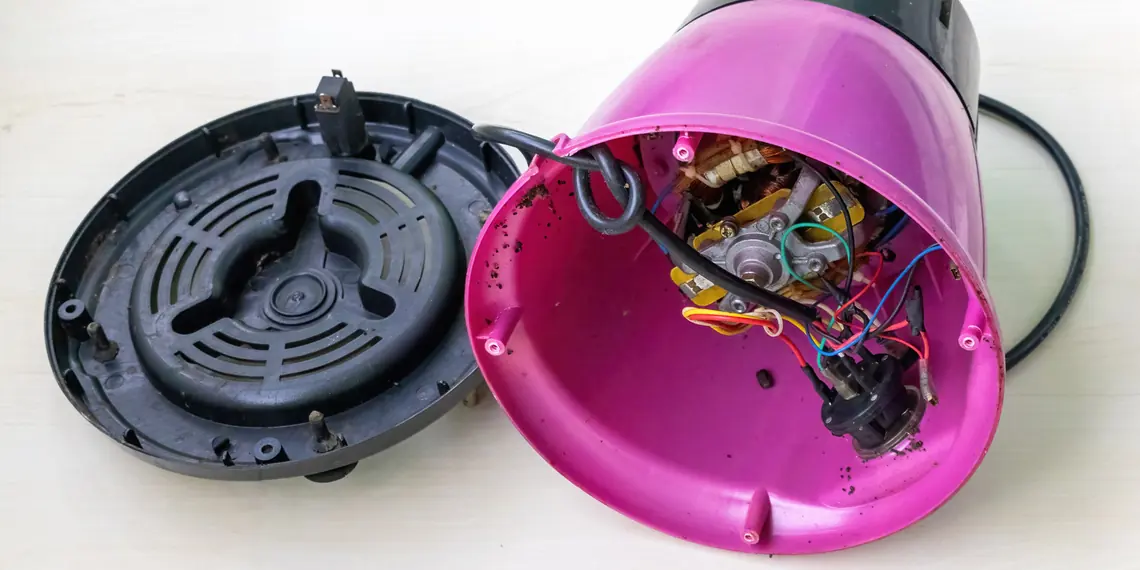
| Motor | Failure, electrical problems | Rarely worth it outside warranty |
Check your manufacturer’s parts pages, for example Vitamix, Ninja or Oster, and always match parts to your exact model number.
Most blender problems are a worn part, not a dead blender. Gaskets, couplings and blade assemblies are cheap. Motors aren’t.
Repair or replace? A simple rule of thumb
Repair if:
- The problem is a gasket, coupling, blade assembly, jar or lid
- The replacement part costs a fraction of a new blender
- The motor still runs strongly and smoothly
- The blender is still under warranty (contact the manufacturer first)
Replace if:
- The motor is failing, overheating on light jobs or smells burnt during normal use
- There are electrical problems, smoke or sparks
- Replacement parts cost close to the price of a new blender
- Parts are no longer available for your model
- Your needs have changed (for example, you now want smoothie bowls and nut butter, which need a more powerful blender)
Check your warranty first. Many blenders are covered for years, and a warranty claim may get you a repair or replacement at little or no cost.
How to make your blender last longer
- Load it right: liquids first, frozen last. Here’s why ingredient order matters.
- Use enough liquid and don’t overfill.
- Blend in short bursts for heavy jobs, and let it rest if it gets warm.
- Keep hard objects out: pits, bones, utensils.
- Clean it straight away with the 60-second method.
- Keep the motor base dry and the drive socket clean.
- Check the gasket regularly and replace it when it’s worn.
- Store it with the lid off so the jar can air out.
Shopping for a replacement?
- Match the type to your needs. Our blender types guide helps.
- Don’t choose on wattage alone. See our blender wattage guide.
- Compare warranties. Longer warranties usually signal longer-lasting motors.
- Check parts availability, so gaskets, blade assemblies and jars are easy to buy later.
Frequently asked questions
How long does a blender usually last?
It varies by type, use and care. Personal blenders often last a few years, full-size blenders several years, and high-performance blenders frequently many years. Warranty length is a good clue to expected lifespan.
How do I know if my blender motor is dying?
Warning signs include a burning smell during light, liquid-rich blends, frequent overheating shutdowns, weak performance on jobs it used to handle, and electrical problems like flickering controls or sparks.
Is it worth repairing a blender?
Often, yes, if the problem is a gasket, coupling, blade assembly or jar, which are usually affordable. Motor failures and electrical problems outside warranty are usually not worth repairing.
Why does my blender smell like burning when it’s new?
A faint smell during the first few uses is common as the motor breaks in. If it’s strong, persists, or comes with smoke, stop and contact the manufacturer.
How can I make my blender last longer?
Load liquids first, don’t overfill, blend in short bursts for heavy jobs, keep hard objects out, clean it straight away, keep the base dry and replace worn gaskets.
The bottom line
A well-cared-for blender can last many years, and most problems are worn, replaceable parts, not a dead blender. Replace gaskets, couplings and blade assemblies when they wear out, check your warranty, and only buy new when the motor or electrics fail, or when your needs have outgrown your blender.

We research blenders so you don't have to: we compare specs, warranties and thousands of owner reviews, and write practical guides for getting more out of the blender you already have.