Can You Sharpen Blender Blades? (And What to Do Instead)
Why most blender blades aren't meant to be sharp, the myths to ignore, and when to replace them
As an Amazon Associate I earn from qualifying purchases. If you buy through links on this page, we may earn a small commission at no extra cost to you. Details.
Your blender isn’t blending like it used to. Smoothies come out chunky, ice takes forever, and you’re starting to wonder: are the blades dull? Can you sharpen them?
It’s a reasonable question, but in most cases the answer is no, and you probably don’t need to. Most blender blades aren’t designed to be razor sharp in the first place, and poor blending usually has a different cause.
This guide explains how blender blades actually work, the popular “sharpening” myths (including the eggshell trick), how to tell whether your blades are really the problem, and what to do instead.
Safety first: Always unplug the blender before touching the blades. Even “dull” blender blades can cut. Handle blade assemblies by their base, and never reach into the jar while it’s plugged in.
How blender blades actually work
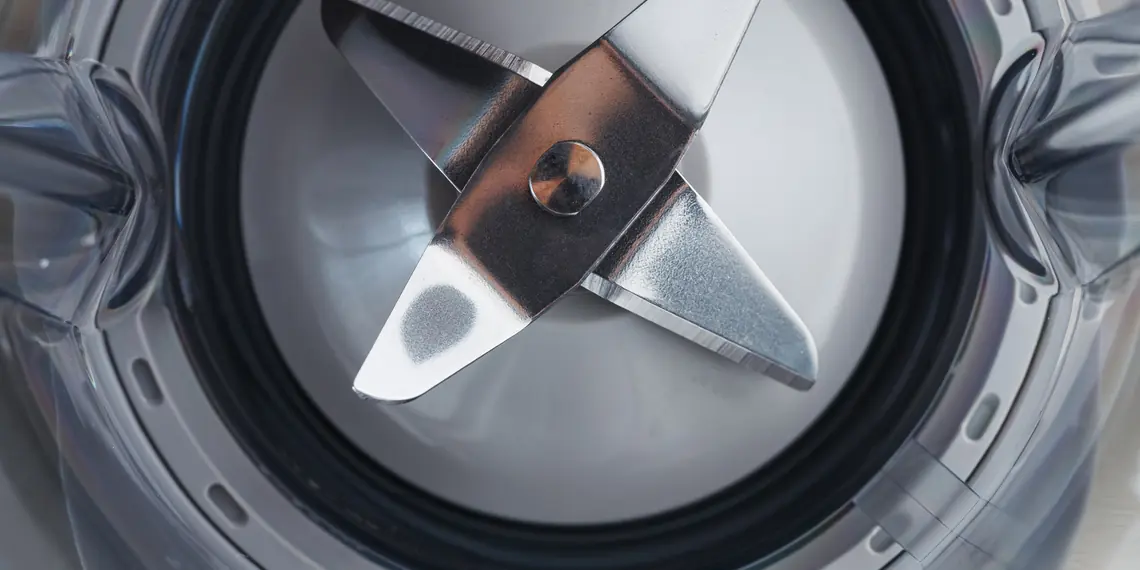
It’s natural to think of blender blades like kitchen knives: sharp edges slicing food. But most blenders, especially high-performance ones, work more like a very fast hammer than a knife.
- Speed does the work. The blades spin at very high speed, and ingredients are smashed, torn and pulverized as they’re pulled through the vortex.
- Blunt-ish blades are normal. Many high-performance blenders deliberately use fairly blunt, thick blades that resist wear from ice and frozen fruit and stay effective for years.
- Shape matters more than edge. The angle, number and position of the blade wings determine how well the blender pulls food down and breaks it up.
That’s why a blender can crush ice and grind grains without a sharp edge, and why sharpening often isn’t the fix people expect.
Can you sharpen blender blades?
Technically, on some models, yes. Practically, it’s rarely a good idea.
- Most manufacturers don’t recommend it. Check your manual, since many say to replace the blade assembly rather than sharpen it.
- It can unbalance the blades. Removing metal unevenly can cause vibration, noise and extra wear on the bearing and motor.
- It’s awkward and risky. Blade assemblies are small, oddly shaped and often permanently fixed to the jar base. Getting a file or stone in there safely is hard.
- It usually doesn’t fix the real problem. If blending has got worse, the cause is often technique, a worn drive coupling or a worn bearing, not a dull edge.
Exception: Some personal blenders and food processors use thinner, sharper blades designed to slice. These can dull over time. Even then, most manufacturers sell replacement blades, which is the safer option.
Myths to ignore
“Blend eggshells to sharpen the blades”
This is one of the most repeated kitchen myths. The idea is that blending eggshells (or ice) sharpens the blades. It doesn’t. Hard objects hitting a blade can only chip or round the edge further, not sharpen it. Blending eggshells also leaves grit in the jar and can scratch plastic containers.
“Blend ice to sharpen the blades”
Same idea, same answer. Ice doesn’t sharpen blades. Crushing ice is fine in blenders designed for it, but it isn’t a maintenance treatment. See our guide on crushing ice in a blender for the right technique.
“Rice or salt will hone the edge”
Grinding rice or coarse salt is sometimes suggested as a “sharpening” trick. It won’t sharpen anything, and very hard dry ingredients can scratch jars. Some blenders have dry-grinding containers for grains, so check your manual before grinding anything dry.
Is it really the blades? How to tell
Before blaming the blades, rule out the more common causes:
| Symptom | More likely cause | Where to look |
|---|---|---|
| Blades spin but food doesn’t move | Air pocket, not enough liquid | Blender not blending |
| Motor runs, blades barely turn | Worn drive coupling | Why a blender smells like burning |
| Grinding or squealing, blade wobbles | Worn blade bearing | Inspect the blade assembly |
| Leaking from under the blades | Worn blade seal | Blender leaking from the bottom |
| Chunky results only with thick blends | Technique or blender power | Loading order, liquid, tamper |
Inspect the blades
With the blender unplugged:
- Look for damage. Bent, chipped, cracked or rusted blades should be replaced.
- Check the wings. On multi-wing blades, all the wings should sit at their original angles. A blade bent by a spoon or fruit pit won’t blend evenly.
- Turn the blade by hand (carefully, from underneath if you can). It should turn smoothly without grinding, wobbling or stiffness.
- Check for play. If the blade moves up and down or side to side, the bearing is worn.
If the blades look straight and intact and the bearing turns smoothly, your blades are probably fine. Look at technique, liquid and the drive coupling instead.
What to do instead of sharpening
1. Improve your technique
Most “dull blade” complaints disappear with better blending habits:
- Liquids first, frozen last. See the right order to add ingredients.
- Enough liquid to form a vortex.
- Start low, then go high.
- Use a tamper for thick mixtures.
- Don’t overfill the jar.
2. Replace the blade assembly
If the blades are genuinely damaged or the bearing is worn, replace the blade assembly. For many blenders, especially models with removable blades, this is an affordable part. If the blades are built into the jar, you’ll need a replacement jar. Check your manufacturer’s parts pages, such as Vitamix, Ninja or NutriBullet, and match the part to your exact model number.
3. Replace the gasket while you’re at it
If your blade assembly has a separate sealing ring, a new gasket is cheap and helps prevent leaks.
Blender blades work by speed, not sharpness. If blending gets worse, fix the technique or replace the part, but don’t reach for a sharpener.
How to make your blades last longer
- Never put utensils in the jar while it’s running or plugged in.
- Remove pits, bones and hard stems before blending.
- Don’t run the blender empty or dry unless the manual says your container is designed for it.
- Clean promptly so sugary residue doesn’t dry around the blade. Our 60-second cleaning method is gentle on blades and bearings.
- Avoid long soaks of blade assemblies that aren’t designed to be submerged, since soaking can wash lubricant out of the bearing.
- Dry the blade assembly thoroughly to prevent rust on carbon-steel parts.
Handy tools
Frequently asked questions
Do blender blades need to be sharp?
Not usually. Most blenders, especially high-performance models, work by spinning fairly blunt blades at very high speed to smash and pulverize food. Blade shape and speed matter more than a sharp edge.
Does blending eggshells sharpen blender blades?
No. It’s a myth. Hard objects can only chip or round the blades further, and eggshells leave grit and can scratch the jar.
How do I know if my blender blades need replacing?
Replace them if they’re bent, chipped, cracked or rusted, or if the blade wobbles, grinds or feels stiff when turned by hand (unplugged). Leaks from under the blades also point to a worn seal in the blade assembly.
Can I sharpen blender blades with a knife sharpener?
It’s not recommended. Blade assemblies are awkward to sharpen safely, uneven sharpening can unbalance the blades, and most manufacturers recommend replacing the blade assembly instead.
Why does my blender not blend as well as it used to?
Usually because of technique (too little liquid, wrong loading order, overfilling), a worn drive coupling, or a worn blade bearing, rather than dull blades.
The bottom line
In most cases, you can’t, and don’t need to, sharpen blender blades. Blenders work by speed and blade shape, not razor edges. Skip the eggshell and ice “sharpening” myths, check your technique and the drive coupling first, and if the blades are bent or the bearing is worn, simply replace the blade assembly.
Not sure your blender is worth repairing? See how long blenders last, and when to repair or replace yours.

We research blenders so you don't have to: we compare specs, warranties and thousands of owner reviews, and write practical guides for getting more out of the blender you already have.