How Many Watts Does a Blender Need? A Plain-English Wattage Guide
What wattage really tells you, how much power each job needs, and what matters more than the number
As an Amazon Associate I earn from qualifying purchases. If you buy through links on this page, we may earn a small commission at no extra cost to you. Details.
Blender boxes love big numbers: 900 watts, 1,200 watts, 1,500 watts, “2 peak horsepower”. It’s natural to assume more watts means a better blender.
Wattage does matter, but it’s only part of the story, and the number on the box doesn’t always mean what you think. A well-designed blender with a moderate motor can outperform a poorly designed one with a bigger number.
This guide explains what blender wattage actually tells you, how much power different jobs typically need, why “peak” power can be misleading, and the features that matter just as much.
How we researched this: This guide is based on how blender motors and containers are designed, manufacturer specifications and long-term feedback from owners. The wattage ranges below are general guidance, not strict rules. Always check the specific model’s specifications and manual.
What does blender wattage mean?
Wattage is a measure of how much electrical power the motor draws. In general, a higher-wattage motor can:
- Keep the blades spinning under heavy loads (thick smoothies, frozen fruit, nut butter)
- Recover speed faster when the blades hit something hard
- Run longer before straining (though heat management matters too)
But wattage measures power drawn, not blending results. How much of that power actually reaches the food depends on the motor’s efficiency, the blade design, the jar shape and the controls.
Rated watts vs. peak watts vs. horsepower
Manufacturers describe power in different ways, which makes comparisons tricky:
| Term | What it usually means | What to watch for |
|---|---|---|
| Rated / continuous watts | Power the motor draws under typical sustained use | The most useful number for comparison, when listed |
| Peak watts | The maximum power drawn for a very short moment, often at startup | Can be much higher than what the blender sustains while blending |
| Horsepower (HP) | Another way of expressing motor power, often “peak HP” | Usually a peak figure, so not directly comparable to rated watts |
Tip: When comparing blenders, try to compare like with like: rated watts to rated watts. If one brand lists peak power and another lists rated power, the numbers aren’t directly comparable. The manual or spec sheet often gives more detail than the box.
How many watts do you need? Rough guide by task
These are general ranges to help you narrow your search. Blade design and jar shape can move a blender up or down these bands.
| What you mostly make | Typical power range to look for | Notes |
|---|---|---|
| Protein shakes, simple smoothies with fresh fruit | Around 300–600 W | Many personal blenders sit here |
| Smoothies with frozen fruit and greens | Around 600–1,000 W | Look for a good blade design; a tamper helps |
| Crushing ice and frozen drinks | Around 700–1,200 W | An ice-crush setting or pulse helps. See crushing ice |
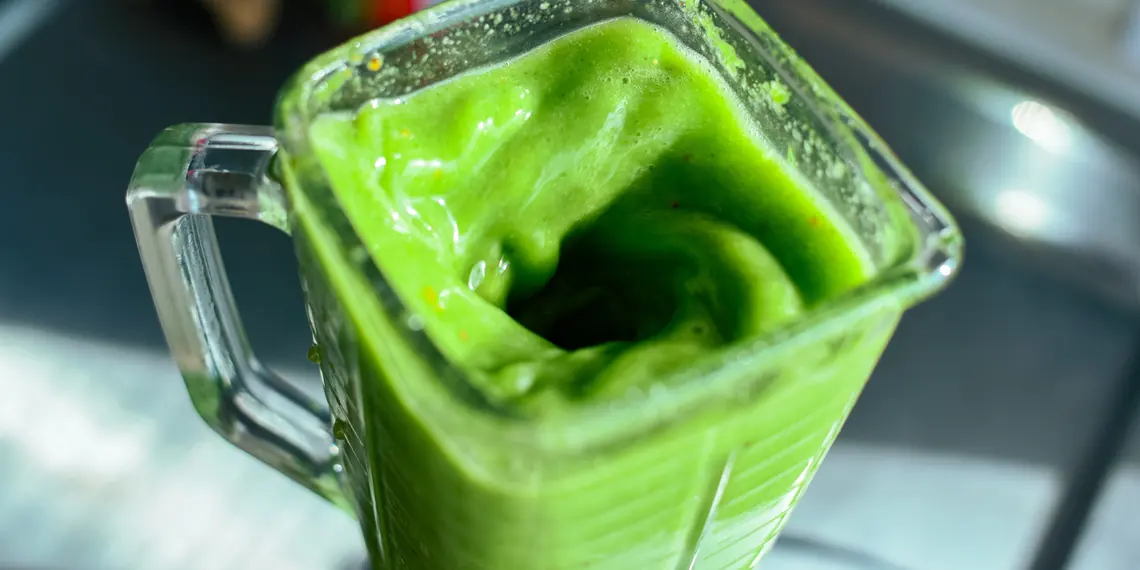
| Silky green smoothies with kale, nuts and seeds | Around 1,000 W and up | High-performance blenders excel here |
| Nut butter, thick smoothie bowls, frozen desserts | Around 1,000 W and up, with a tamper | See nut butter in a blender |
| Hot soups made in the blender | High-performance models designed for it | Only if the manual allows. See blending hot soup safely |
Immersion blenders usually have lower wattage (often a few hundred watts) because they’re used for soups, sauces and small jobs rather than ice and frozen fruit.
What matters as much as wattage
1. Blade design
The shape, angle and number of blade wings determine how well the blender pulls ingredients down and breaks them up. A great blade design with moderate power can beat a poor design with high power.
2. Container shape
The jar’s shape controls the vortex. Narrow-bottomed jars keep small amounts moving around the blades, while wide jars suit big batches but may need more liquid or a tamper for thick blends.
3. Speed control
Variable speed lets you start slow to pull ingredients into the blades and then ramp up. That’s better for texture, safety with hot liquids, and motor strain than a single high setting.
4. Tamper
A tamper lets you push thick, frozen mixtures into the blades while the blender runs, often mattering more than a few hundred extra watts for smoothie bowls and nut butter.
5. Motor protection and cooling
Thermal overload protection shuts the motor off before it overheats. Good cooling lets a blender handle long, heavy blends. If your blender often overheats, see why a blender smells like burning.
6. Warranty
Warranty length is one of the clearest signs of how long a manufacturer expects the motor to last. A long warranty on a moderately powered blender can be worth more than a big wattage number with a short warranty.
Watts tell you how hard a motor can work. Blade design, jar shape and speed control decide how well that work turns into a smooth blend.
Does a higher-wattage blender use more electricity?
A higher-wattage blender can draw more power while it runs, but blenders run for very short periods, often a minute or two at a time. For most households, the effect on the electricity bill is small. Higher-wattage blenders can also finish jobs faster.
If you want to check your appliance’s energy use, the U.S. Department of Energy’s appliance energy guidance explains how to estimate it from wattage and run time.
Is more power ever a downside?
- Price: More powerful blenders usually cost more.
- Noise: Powerful motors are often louder. See how to make a blender quieter.
- Size: High-performance blenders can be tall and heavy. Check the height under your cabinets.
- Overkill: If you only make protein shakes, you don’t need a 1,500-watt machine.
Which blender type fits your needs?
- Mostly single-serve shakes and simple smoothies: a personal blender is often enough.
- Family smoothies and frozen drinks: a full-size blender with good ice performance.
- Daily green smoothies, nut butter, frozen desserts: a high-performance blender with a tamper.
- Soups and sauces: an immersion blender, possibly alongside a countertop blender.
Our guide to personal, full-size and high-performance blenders explains each type in detail.
Frequently asked questions
How many watts is good for a blender?
It depends on what you make. Simple shakes can work with a few hundred watts, frozen-fruit smoothies and ice usually benefit from roughly 700–1,000 watts or more, and nut butters and very thick blends are easiest with high-performance blenders of around 1,000 watts or more plus a tamper.
Is a 1,000-watt blender good for crushing ice?
Often, yes, if it also has a good blade design and an ice-crush or pulse setting. Wattage alone doesn’t guarantee good ice crushing.
What’s the difference between peak watts and rated watts?
Peak watts is the maximum power drawn for a very short time, often at startup. Rated or continuous watts is closer to what the motor uses during normal blending, which makes it better for comparing blenders.
Do more watts mean a better blender?
Not necessarily. Blade design, jar shape, speed control, a tamper, motor protection and warranty all matter as much as wattage.
How many watts does a blender need for green smoothies?
For silky-smooth green smoothies with kale and seeds, high-performance blenders (often around 1,000 watts or more) usually do best. Lower-powered blenders can work if you blend greens with liquid first.
The bottom line
Wattage is a useful starting point, but it’s not the whole picture. Match the power to what you actually make, compare rated watts where you can, and give equal weight to blade design, jar shape, speed control, a tamper and warranty. A thoughtfully designed blender will outperform a bigger number on the box.
Want to get more from the blender you already have? Start with the right order to add ingredients.

We research blenders so you don't have to: we compare specs, warranties and thousands of owner reviews, and write practical guides for getting more out of the blender you already have.